No historian has produced a defensible figure for Mansa Musa’s net worth in today’s money. The $400 billion number that circulates online traces to a 2012 aggregator list with no published method, and the careful sources we read say his wealth cannot be pinned to a number.
As Money put it in 2015, there is really no way to put an accurate number on it. This guide is an evidence review: what the sources actually say about the 1324 pilgrimage, where the $400 billion figure came from, and what we could not verify.
Most pages on this topic repeat the biggest number they can find. We grade each claim by its source instead and say plainly where the evidence stops.
Mansa Musa Net Worth in Today’s Money: The Short Answer
There is no sourced answer. The $400 billion figure is an aggregator estimate from October 2012, labelled an inflation-adjusted list, and the aggregator itself says its figures are only estimates. Historians quoted by Money and HISTORY describe his wealth as impossible to quantify, because there are no treasury inventories and no market price for a king’s holdings.
Mansa Musa Net Worth Context: Reign and Uncertain Dates
Mansa Musa ruled the Mali Empire in West Africa and is remembered for his pilgrimage to Mecca in 1324. His reign dates are not settled. Encyclopedia.com says he became ruler around 1307 and died in 1337, adding that some sources say 1332.
An aggregator page gives 1312 to 1337, and a Britannica search summary we could not open gave 1307 or 1312 with a death date of 1332 or 1337. We use circa 1312 to circa 1337 and treat the dates as uncertain.
The 1324 Pilgrimage: What the Medieval Account Says
The main medieval source is the Arabic writer al-Umari, in a passage translated in the Corpus of Early Arabic Sources for West African History, edited by Levtzion and Hopkins and published by Cambridge University Press in 1981. According to that account, Musa sent loads of unworked gold and other valuables to the royal treasury in Cairo and gave a load of gold to every court emir and holder of royal office.
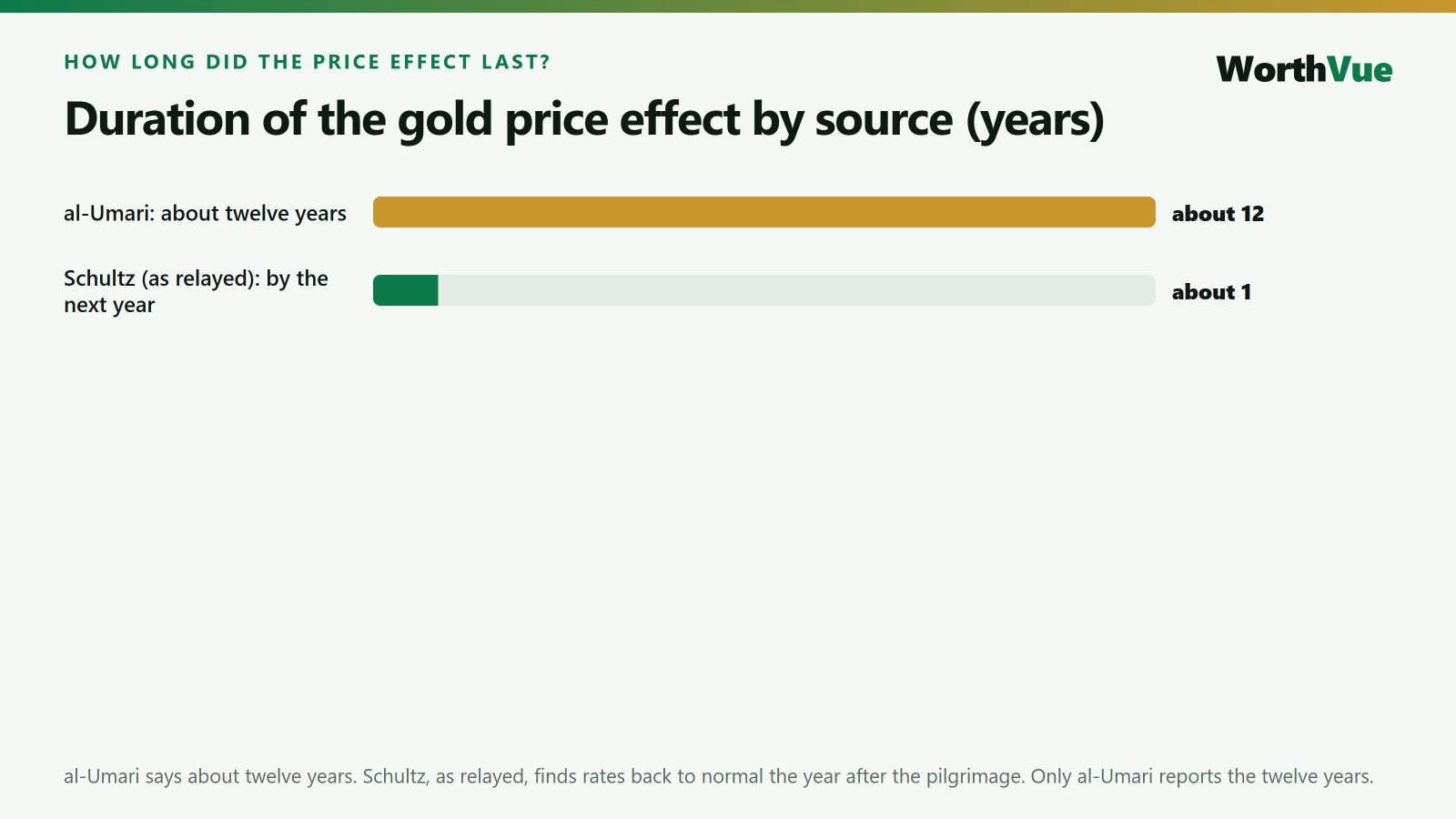
Al-Umari writes that the gold they exchanged pushed its price down in Egypt: a mithqal of gold that had not sold below 25 dirhams later sold for 22 dirhams or less, and al-Umari says this lasted about twelve years until his time.
The account gives no total weight of gold and no modern value. It is a report of a price effect in one city, not an inventory of the king’s wealth.
Did the Gold Price Really Crash for Twelve Years?
A scholarly challenge exists. A fact-check on Ancient Origins relays the work of Warren Schultz of DePaul University, from 2006. According to that relay, the twelve-year claim rests on al-Umari alone, recorded exchange rates from about 1299 to 1349 show 20 dirhams per gold coin as the most common rate with a return to it the year after the pilgrimage, and the dip was one of many short-term fluctuations.
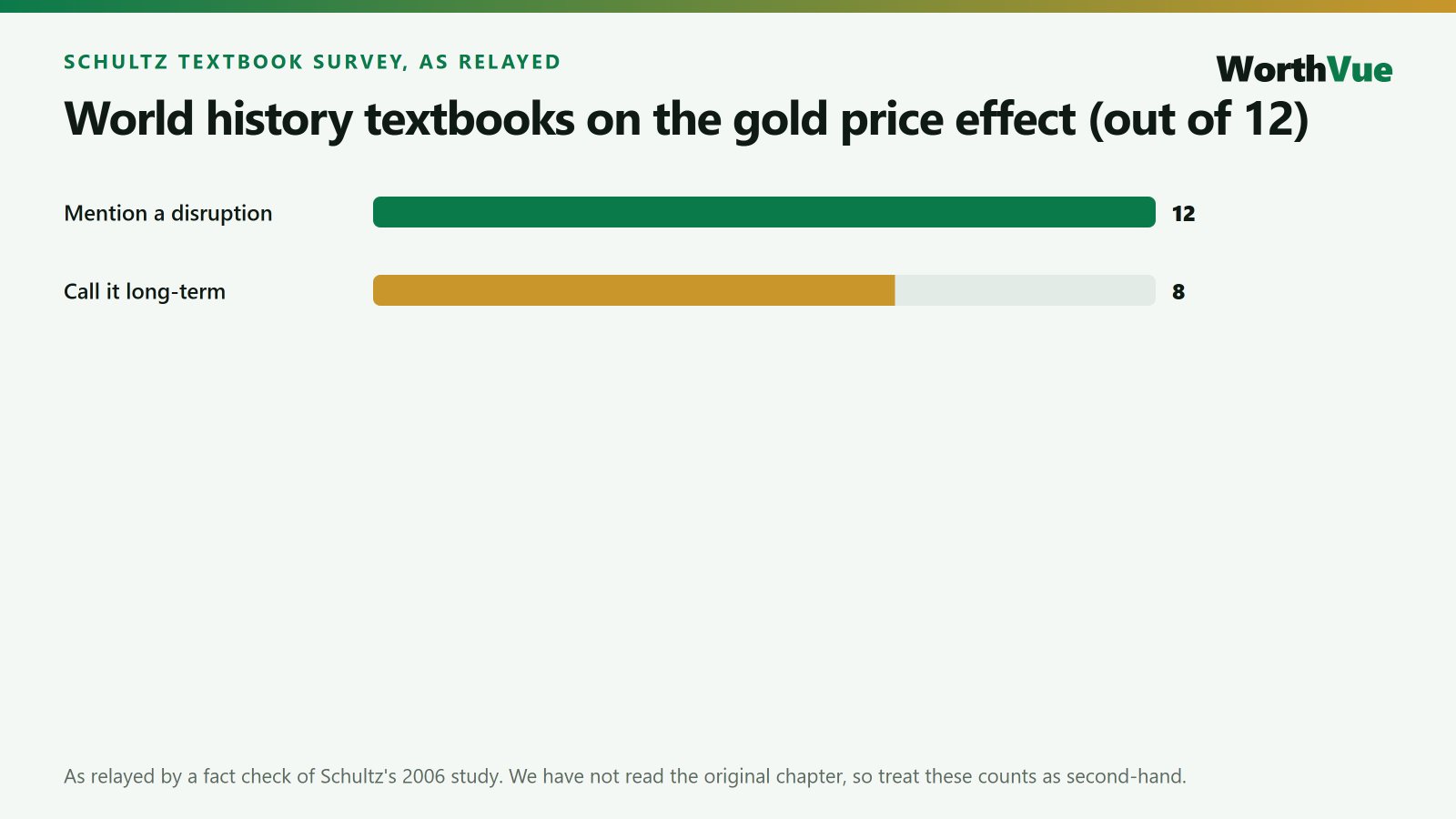
The same relay says later Arabic writers gave different sizes for the fall: Ibn Kathir two dirhams, al-Maqrizi six dirhams. Schultz also reportedly surveyed 12 world history textbooks, finding that all 12 mention a disruption and 8 call it long-term. We have not read Schultz’s chapter, so treat these points as second-hand.
How the Medieval Reports Compare
The sources disagree on both the size of the price fall and how long it lasted. Our charts show how long the effect lasted by source and how many textbooks call it long-term.
The 1375 Catalan Atlas: A European View of His Wealth
The British Library describes the 1375 Catalan Atlas, held in Paris, as showing Musa with a gold crown and a sceptre and a round gold object that could be an orb, a coin or a nugget. In translation, the caption calls him the richest and noblest ruler of the region because of the abundance of gold in his lands. This is a contemporary European map caption. It is evidence of his reputation, not a valuation.
Where the $400 Billion Mansa Musa Net Worth Figure Came From
The Ancient Origins fact check traces the earliest reports it could find to NPR’s Morning Edition on 16 October 2012, which cited an inflation-adjusted list from Celebrity Net Worth, with the New York Daily News repeating it two days later. We could not open the NPR page, so we rely on that fact check for the date. The aggregator’s own page lists $400 billion as a modern equivalent, shows no method, and says its figures are only estimates unless indicated.
HISTORY, in an article updated in 2025, gives no dollar figure and calls his riches nearly impossible to quantify. The BBC, as relayed by the fact check, said in 2019 that economic historians agree the wealth is impossible to pin to a number.
Why Converting Mansa Musa Net Worth to Dollars Fails
This section is our own analysis, not a sourced claim. A conversion needs a stock of assets and a price for them. For Mansa Musa we have neither: no treasury inventory, no weight of gold taken on the pilgrimage, and no market price for a ruler’s holdings.
The one price we do have, 25 to 22 dirhams for a mithqal in Cairo, is a local price after his spending, and the aggregator itself notes that the gold-giving devalued gold in Cairo and Medina, which complicates any comparison across eras.
Evidence Grades for Mansa Musa Net Worth Claims
| Claim | Source | Our grade |
|---|---|---|
| He gave gold to Cairo’s emirs and its price fell | al-Umari translation, Cambridge 1981 | Strong for the event, size uncertain |
| The price effect lasted about twelve years | al-Umari only | Weak, challenged by Schultz |
| His wealth cannot be put into a number | Money 2015, HISTORY 2025 | Strong |
| He was seen as the richest ruler of his region | 1375 Catalan Atlas caption | Strong as reputation, not valuation |
| His net worth is $400 billion | Aggregator list, 2012, no method | Unverified |
What We Could Not Verify
- Britannica. Both Britannica pages returned an access error, so we use no Britannica text.
- Ibn Khaldun’s account. We did not read his text, so we do not quote him.
- Sources of Mali’s wealth. We did not read a source we could cite for the roles of gold, salt and trade, so we do not describe them in detail.
- Schultz and the BBC. Both are relayed through a fact-check page and not verified against the originals.
- The NPR 2012 segment. The page would not open, so its date rests on the fact check.
- Gold tonnage and any scholarly dollar conversion. We found no opened source offering either.
What is Mansa Musa’s net worth in today’s money?
No sourced figure exists. The $400 billion number is an aggregator estimate with no published method.
Was Mansa Musa the richest person in history?
Medieval and modern sources call him extremely rich, and a 1375 map calls him the richest ruler of his region. No source we read can rank him against other fortunes in a defensible way.
How much gold did Mansa Musa take on his pilgrimage?
We found no verified weight. Al-Umari describes loads of gold given to officials and sent to the treasury but gives no total.
Did Mansa Musa really crash the price of gold in Egypt?
Al-Umari reports a fall from 25 to 22 dirhams for a mithqal. A 2006 study relayed by a fact check argues the effect was short-term, and later writers gave different sizes.
Was Mansa Musa richer than Elon Musk?
We cannot say. With no sourced value for his wealth, any comparison with a modern fortune would be invented.
Key Takeaways
- No historian-backed Mansa Musa net worth figure exists in today’s money.
- The $400 billion number comes from a 2012 aggregator list with no published method.
- Al-Umari reports a Cairo gold price fall from 25 to 22 dirhams after 1324, but a 2006 study challenges how long it lasted.
- The Catalan Atlas shows his reputation as richest in his region, not a valuation.
- Be wary of any page that gives a single dollar figure.
More on WorthVue: compare how we handle uncertain wealth in highest paid actress and Blippi’s brand economics, browse all guides, and read the methodology page for how we treat estimates.
Sources
- Money: The 10 Richest People of All Time (2015)
- HISTORY: Who was the richest man in history, Mansa Musa
- Al-Umari's account of Mansa Musa's visit to Cairo (Levtzion and Hopkins, 1981)
- British Library: African kings on medieval and renaissance maps
- Boston University African Studies: Kingdom of Mali
- Encyclopedia.com: Mansa Musa makes his hajj
- Ancient Origins: Mansa Musa $400 billion fact check
Last updated November 2026. Spotted an error? Send a correction with a source.
More from Guides
Comic Book Grading Cost in 2026: Real CGC Fees, 3 Examples

Spotify Royalties Per Stream 2026: Real Dollar Breakdown

Blippi Pay Per Episode 2026: The Complete Money Picture
